
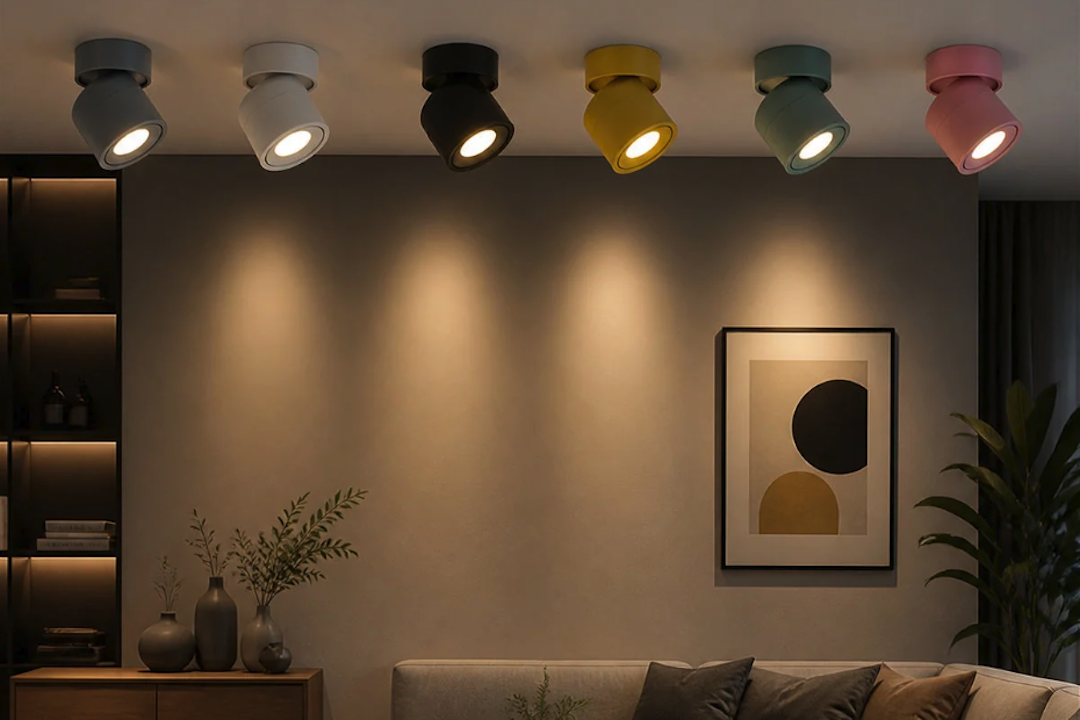
Choosing the best surface-mounted spotlight for your space really boils down to understanding what you need it to do and where it’s going. It’s not just about picking something that looks good; it’s about light quality, functionality, and how it integrates into your existing setup. We’ll walk through the practical considerations to help you make an informed decision without getting bogged down in jargon or sales pitch.
Getting Started: Understanding Your Lighting Needs
Before you even glance at a catalog, take a moment to consider what you’re trying to achieve with a spotlight Blukon. Are you highlighting a piece of art, illuminating a dark corner, or adding general ambient light? Each purpose will point you towards different features and specifications. Think about the mood you want to create and the specific objects or areas you want to draw attention to.
Defining the Spotlight’s Purpose
This is your foundational step. A spotlight isn’t just a generic light source; it’s a focused beam designed to accentuate.
Are you illuminating a gallery wall? You’ll need a narrow beam and good color rendering.
Is it for a kitchen task area? You’ll want bright, focused light with a wide enough spread to cover your workspace without shadows.
Perhaps it’s for architectural detailing, like washing light across a textured wall. Here, beam angle and light uniformity become critical.
Thinking through these specific use cases will immediately start narrowing down your options and prevent you from over-specifying or under-specifying your needs.
Assessing the Environment
Where will this spotlight live? Is it indoors or outdoors? In a damp bathroom or a dry living room? The environment dictates the necessary protection rating (IP rating) and material durability.
For outdoor use, you’ll need a much higher IP rating (like IP65 or IP66) to withstand rain, dust, and temperature fluctuations.
Bathrooms or kitchens might require an IP44 or higher to handle splashes and humidity.
For indoor, dry areas, a lower IP rating (e.g., IP20) is usually sufficient, giving you more flexibility in design choices.
Also, consider the existing ceiling or wall material. Surface-mounted lights don’t require cutouts like recessed lights, but you still need a stable surface for mounting and access to electrical wiring.
Key Technical Specifications and What They Mean
Once you have a clearer idea of your needs and environment, it’s time to delve into the technical side. Don’t worry, we’ll break down the jargon into practical insights. These specifications are crucial for ensuring the spotlight performs as expected.
Lumens and Wattage: Brightness Explained
Forget the old wattage equivalency for traditional bulbs. For LEDs, lumens (lm) are your true measure of brightness.
Lumens tell you how much light the fixture emits. More lumens mean a brighter light.
How many lumens do you need?
For accent lighting, you might be looking at 200-500 lumens per spotlight to highlight an object.
For task lighting, like over a kitchen counter, you might need 500-800 lumens or more, especially if you’re using multiple spots.
For general ambient light in a small space, several well-placed 400-600 lumen spots could work.
Wattage (W), on the other hand, tells you how much energy the light consumes. For LEDs, lower wattage usually means greater energy efficiency for a given lumen output. Focus on lumens first, then consider wattage for energy consumption. A 10W LED might produce 800 lumens, which is very efficient.
Color Temperature: Setting the Mood (CCT)
Color temperature, measured in Kelvins (K), describes the warmth or coolness of the light.
Warm White (2700K-3000K): Think cozy, inviting, relaxing. Great for living rooms, bedrooms, or dining areas where you want a comfortable ambiance. It mimics the glow of incandescent bulbs.
Neutral White (3500K-4000K): A balanced light, often preferred for workspaces like offices, kitchens, or bathrooms where clarity is important but without a harsh cool tone. It’s good for general illumination where tasks are performed.
Cool White/Daylight (5000K-6500K): Crisp, bright, and invigorating. Best for areas requiring high visibility, like garages, utility rooms, or specific task lighting in commercial settings. It can feel clinical in a residential setting if not used sparingly.
The right color temperature significantly impacts the mood and functionality of your space, so choose carefully based on the room’s purpose. Some advanced spotlights offer tunable white capabilities, allowing you to adjust the CCT, providing ultimate flexibility.
Color Rendering Index: Seeing True Colors (CRI)
CRI measures how accurately a light source reveals the true colors of objects compared to natural sunlight. It’s rated on a scale of 0 to 100, with 100 being perfect.
For most general lighting, a CRI of 80+ is perfectly acceptable.
However, if you’re lighting artwork, photographs, retail displays, or applying makeup, a high CRI (90 or above) is critical. A low CRI can make colors appear dull, washed out, or even distorted. Imagine a vibrant red painting looking brownish under poor lighting – that’s where CRI matters. Investing in a high CRI spotlight ensures that what you’re highlighting looks its absolute best.
Beam Angle: Focusing the Light
The beam angle dictates how wide or narrow the light spread is.
Narrow Beam (<20 degrees): Creates a dramatic, focused spot. Ideal for accentuating small objects, architectural details, or creating “pools” of light. Think art galleries or highlighting a sculpture.
Medium Beam (20-40 degrees): A versatile choice, offering a good balance between focus and spread. Suitable for general accent lighting, task lighting, or illuminating larger features.
Wide Beam (>40 degrees): Provides a broad wash of light, good for general illumination in smaller spaces, wall washing, or task lighting where a larger area needs even light.
The optimal beam angle depends entirely on what you’re trying to illuminate and from what distance. A narrow beam too close to an object might create a harsh hot spot, while a wide beam from far away might not provide enough focus.
Dimming Capabilities
Do you need to adjust the brightness? If so, you’ll need a dimmable spotlight and a compatible dimmer switch.
Not all LED drivers are dimmable, and not all dimmable drivers are compatible with all dimmer types (e.g., leading edge vs. trailing edge). Always check the specifications of both the spotlight and your existing or planned dimmer switch to ensure compatibility to avoid flickering, buzzing, or non-functional dimming. The best scenario is often a “triac dimmable” driver which offers broad compatibility. Some newer smart lights offer app-controlled dimming or even dim-to-warm features.
Design and Aesthetics: Beyond the Function
While technical specs are crucial for performance, how the spotlight looks and integrates into your space is just as important. Surface-mounted spotlights are visible fixtures, so their design plays a significant role in your room’s overall aesthetic.
Material and Finish
The material and finish of the spotlight body can significantly influence the look and feel of your space.
Materials:
Aluminum: Common, lightweight, durable, and excellent for heat dissipation (important for LED longevity). Often powder-coated.
Steel: Sturdier, can be heavier, often used for more robust or industrial designs. Can be brushed, polished, or painted.
Plastic/Polycarbonate: Lighter, less expensive, but might have reduced heat dissipation properties and a less premium feel. Often used in budget-friendly or very minimalist designs.
Finishes:
Matte Black/White: Modern, minimalist, and often “disappears” into a ceiling, allowing the light to be the focus. Highly versatile.
Brushed Nickel/Chrome: Contemporary, often found in kitchens and bathrooms, complementing stainless steel appliances or chrome fixtures.
Bronze/Brass: Can add a touch of warmth, vintage charm, or industrial chic, depending on the specific shade and finish (e.g., oil-rubbed bronze vs. polished brass).
Custom Colors: Some manufacturers offer custom finishes, which can be useful for branding or highly specific interior design schemes.
Consider how the fixture’s material and finish will interact with your existing decor, ceiling color, and other metal accents in the room.
Size and Shape
Surface-mounted spotlights come in various shapes and sizes.
Cylindrical: A classic, clean look that can be unobtrusive or become a design feature depending on its scale.
Cubic/Square: Modern and architectural, can complement angular design elements.
Rectangular/Linear: Less common for single spotlights but can be found in multi-head fixtures, offering a broader spread of light.
Minimalist Pucks: Very small, low-profile designs that almost disappear against the ceiling, focusing purely on the light output.
The size should be proportionate to the space and the area it’s illuminating. A large, bulky spotlight might overwhelm a small room or delicate artwork, while a tiny one might look lost in a grand space. Also, consider the physical projection from the surface – some are very low-profile, while others extend further, creating more of a statement.
Adjustability and Swivel Options
Many surface-mounted spotlights offer adjustability, allowing you to direct the light precisely where you need it.
Fixed: Some spotlights are stationary once installed, pointing in one direction. These are best when you know exactly where the light needs to go and won’t change your mind, like for general ambient lighting.
Pivoting/Tilting: Allows the light head to tilt up, down, or at an angle. Essential for accent lighting where you need to angle the beam towards a wall, artwork, or specific feature.
Swivel/Rotatable: Allows the light head to rotate horizontally. Combined with tilting, this provides maximum flexibility for aiming the light in almost any direction. This is highly recommended for accent lighting, display lighting, or in rooms where furniture arrangements might change over time.
The degree of adjustability can vary, so check the specifications for the range of motion (e.g., 30 degrees tilt, 350 degrees rotation).
Installation and Compatibility Considerations
Even the best spotlight won’t be useful if it can’t be properly installed or doesn’t play nicely with your existing electrical system. These practical aspects are crucial for a smooth setup.
Power Supply and Wiring
Surface-mounted spotlights usually connect directly to your household electrical wiring (mains voltage, typically 230V in Europe/UK, 120V in North America).
Ensure you have an existing junction box or a suitable power feed at the intended mounting location. If not, you may need an electrician to run new wiring.
Some spotlights integrate their LED driver directly into the fixture, simplifying installation. Others might have an external driver that needs to be concealed, although this is less common for single surface-mounted spots.
Always consult a qualified electrician if you’re unsure about wiring or electrical safety. DIY installation is only recommended if you have the necessary experience and knowledge.
IP Rating for Environmental Protection
As mentioned earlier, the Ingress Protection (IP) rating is crucial, especially for specific environments.
The first digit refers to protection against solid objects (dust, dirt):
0: No protection
1: Protected against solid objects >50mm (e.g., accidental touch by hand)
2: Protected against solid objects >12.5mm (e.g., fingers)
3: Protected against solid objects >2.5mm (e.g., tools, wires)
4: Protected against solid objects >1mm (e.g., small wires, insects)
5: Dust protected (limited ingress, no harmful deposits)
6: Dust tight (no ingress of dust)
The second digit refers to protection against liquids:
0: No protection
1: Protected against vertically falling water drops
2: Protected against vertically falling water drops when tilted up to 15°
3: Protected against spraying water
4: Protected against splashing water
5: Protected against water jets
6: Protected against powerful water jets
7: Protected against immersion (up to 1m for 30 min)
8: Protected against continuous immersion (specified by manufacturer)
Common ratings:
IP20: Standard for dry indoor areas.
IP44: Suitable for bathrooms (Zone 2, away from direct spray) and covered outdoor areas (like porches).
IP65/IP66: Ideal for outdoor use, exposed to weather, or areas with direct water spray (e.g., shower cubicles, car washes).
Compliance and Certifications
Reputable spotlights will come with necessary certifications, ensuring they meet safety and quality standards.
Look for marks like CE (Conformité Européenne) for products sold in the European Economic Area, UL (Underwriters Laboratories) or ETL for North America, and RoHS compliance (Restriction of Hazardous Substances).
These certifications indicate that the product has undergone testing and meets specific safety, health, and environmental protection requirements. Choosing certified products provides peace of mind regarding quality, safety, and longevity.
Smart Features and Advanced Options
The world of lighting is constantly evolving, and spotlights are no exception. Smart features can add convenience, flexibility, and even energy savings to your lighting setup.
Integration with Smart Home Systems
Many modern spotlights can be integrated into your existing smart home ecosystem (e.g., Philips Hue, Apple HomeKit, Google Home, Amazon Alexa, Zigbee, Z-Wave).
This allows you to control your lights via voice commands, smartphone apps, or automated schedules.
You can often group multiple spotlights, create scenes (e.g., “movie night” dimming certain lights and changing color temperature), and schedule lights to turn on/off even when you’re away from home.
Consider if you want individual control over each spotlight or if grouping them is sufficient. This can influence the type of smart spotlight you choose.
Tunable White and RGBW Options
Tunable White: Some advanced spotlights allow you to adjust the color temperature from warm to cool (e.g., 2700K to 6500K) using an app or remote control. This offers immense flexibility, allowing you to change the mood of a room throughout the day or for different activities. You could have warm light in the evening for relaxation and cooler light for focused work during the day.
RGBW (Red, Green, Blue, White): These spotlights can produce millions of colors in addition to white light. While not always necessary for functional lighting, RGBW can be fantastic for creating ambiance, mood lighting, or adding a playful element to a room. Imagine illuminating a feature wall with a vibrant blue or a subtle magenta for a party. The “W” in RGBW is important, ensuring a good quality dedicated white light is available, as RGB LEDs alone often produce a less appealing “mixed” white.
Occupancy and Motion Sensors
For utility areas, hallways, or outdoor security, spotlights with integrated occupancy or motion sensors can be incredibly practical.
They automatically turn on when motion is detected and off after a set period of inactivity, saving energy and providing convenience.
Some sensors are highly configurable, allowing you to set sensitivity, duration, and even ambient light levels (so they don’t turn on during daylight hours). This can be particularly useful in areas where you might have your hands full, like a laundry room or a garage.
By methodically working through these considerations – from your initial needs to the technical details, design elements, installation practicalities, and smart features – you’ll be well-equipped to select the best surface-mounted spotlight that perfectly suits your space and lifestyle. Remember, good lighting isn’t just about brightness; it’s about enhancing your environment and making it more functional and enjoyable.